What we do
Inflammation is the thread.
Our work starts from a clinical problem, finds the molecule that predicts it, works out why that molecule matters, and puts the result back in front of the clinician. Two programs carry that method into the settings where risk is highest.
01
Inflammation and Cardiovascular-Kidney-Metabolic Disease
The heart, the kidney, and metabolism fail together, and inflammation is the common thread. We study the immune signals that carry injury from one organ to another, and we translate them into biomarkers clinicians can act on.
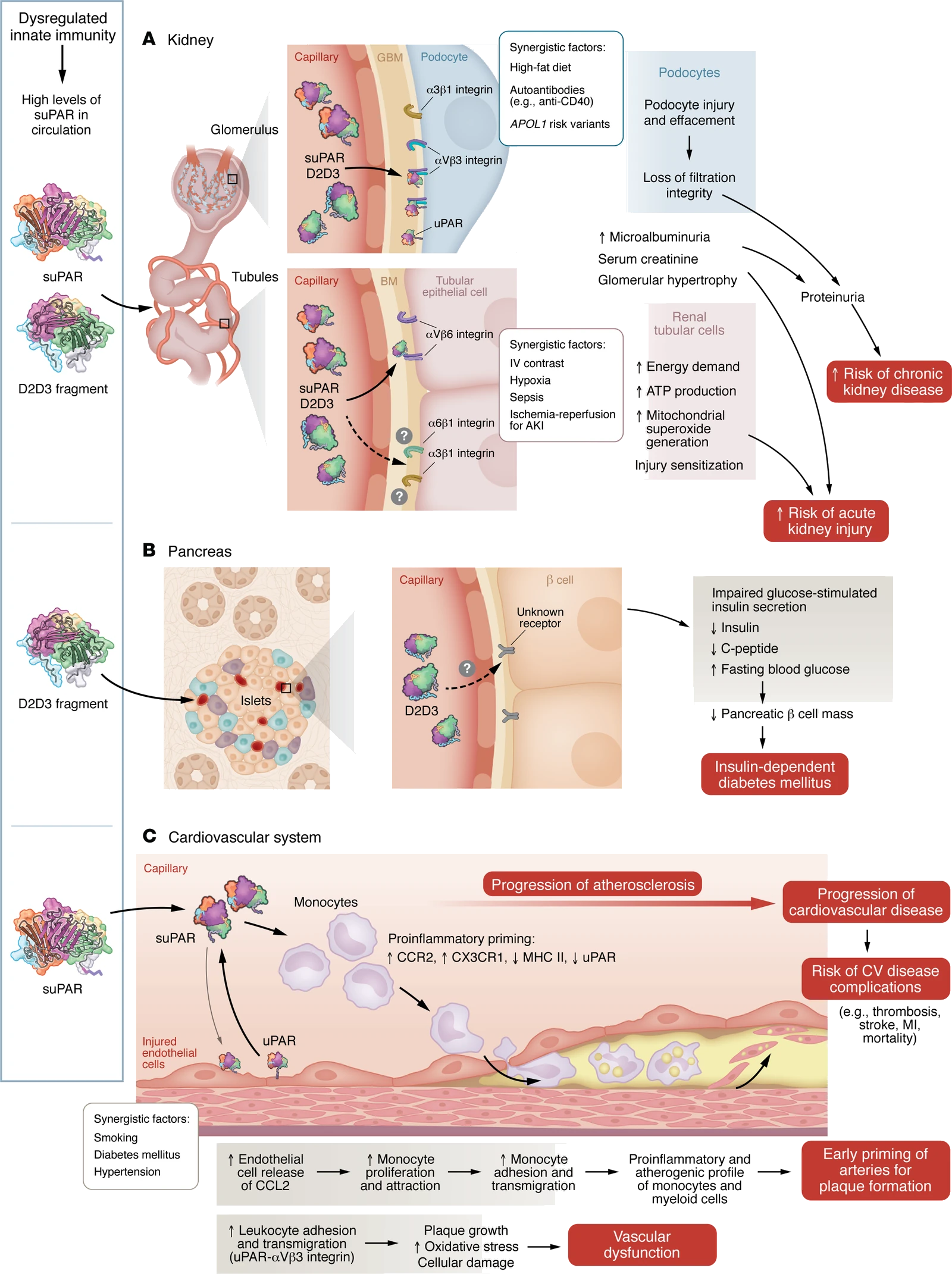
Our defining contribution is suPAR, the soluble urokinase plasminogen activator receptor. Over a decade we established it as an independent predictor of incident chronic kidney disease, traced its mechanism to a tripartite complex with APOL1 risk variants and αvβ3 integrin on podocytes, extended it to acute kidney injury, and showed it modulates monocyte function to promote atherosclerosis. That arc now frames suPAR as a compartmentalized signaling system in cardiovascular-kidney-metabolic syndrome: membrane uPAR drives local inflammation and remodeling, while soluble suPAR mediates injury in distant organs.
Lines of work
- suPAR and the kidney: incident CKD, eGFR decline, AKI, and FSGS
- Mechanism: APOL1, αvβ3 integrin, monocyte priming, uPAR isoforms
- Atherosclerosis, heart failure, and the cardiorenal axis
- Inflammation and outcomes in COVID-19 and critical illness
- Genetics of suPAR and multi-omics integration
Papers by topic
- 61 COVID-19 & Critical Illness
- 50 suPAR & Inflammatory Biomarkers
- 49 Vascular Biology, Atherosclerosis & Prevention
- 35 Nephrology & Cardiorenal
- 14 Heart Failure & Cardiomyopathy
- 11 Basic & Mechanistic Science
A paper can count under more than one topic.
02
Cardio-Oncology
Cancer therapy saves lives and injures hearts. We work out which patients are at risk, how to detect that injury early, and how to treat it without taking effective cancer therapy away.
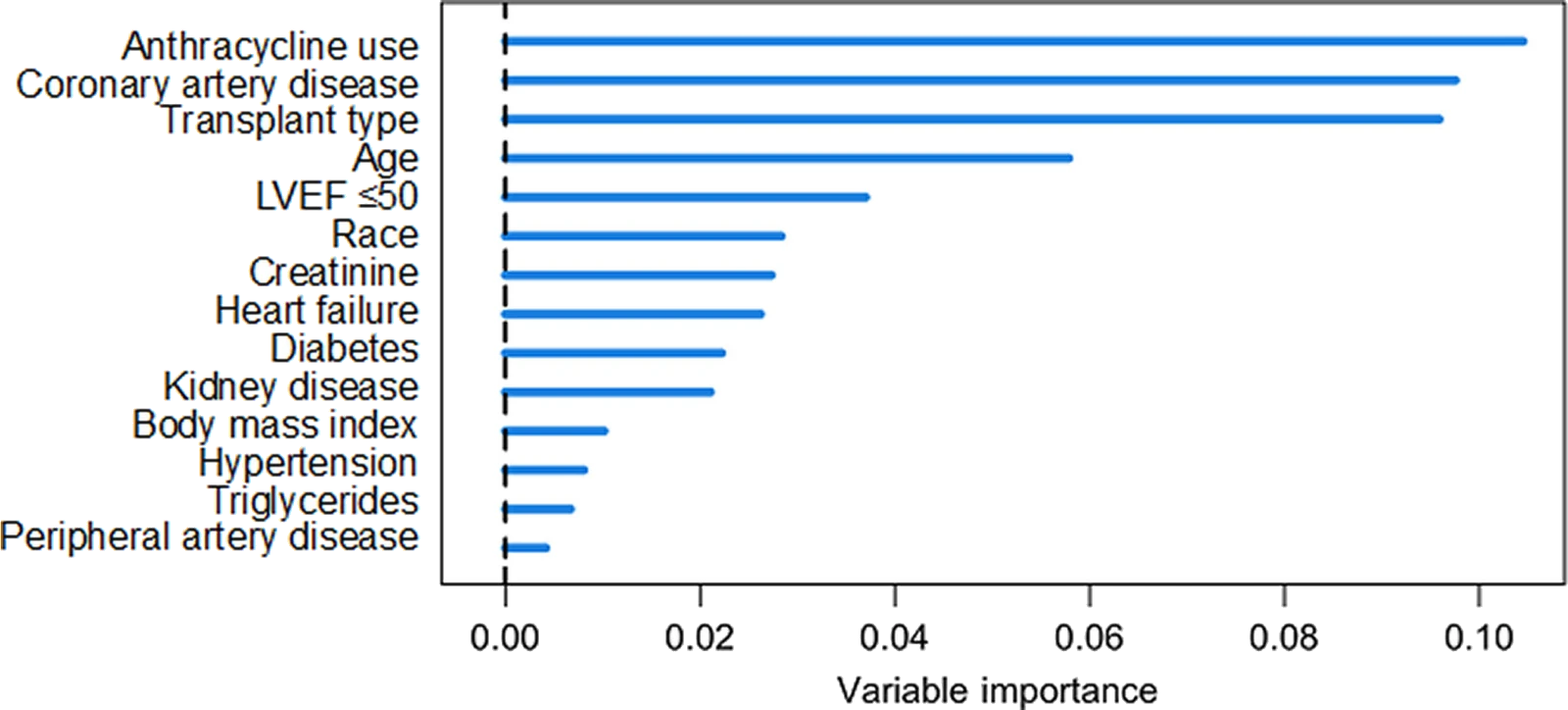
This is now the lab's largest program. Immune-checkpoint-inhibitor myocarditis is the flagship: registry-based diagnosis and prognosis, troponin and ECG predictors, severity scoring, and the thymus biology underlying susceptibility. Alongside it we study anthracycline cardiotoxicity, CAR T-cell cytokine-release cardiomyopathy, and the cardiovascular care of patients undergoing hematopoietic stem cell transplantation, where post-transplant atrial fibrillation turns out to be a sentinel of systemic vulnerability rather than a transient nuisance.
Lines of work
- Immune-checkpoint-inhibitor myocarditis: diagnosis, biomarkers, outcomes
- Anthracycline cardiotoxicity and cardioprotection
- CAR T-cell and cellular-therapy cardiotoxicity
- Cardiovascular care in stem cell transplantation
- Biomarkers in cancer survivors
- Building the cardio-oncology workforce
How we work
Cohorts and biospecimens on one side, mechanism on the other.
Methods
- Clinical cohort and registry studies
- Biomarker discovery and validation
- Biostatistics and machine learning
- Multi-omics integration
- Mechanistic and translational models
- Health systems and implementation science
Cohorts and registries
- Emory Cardiovascular Biobank
- CRIC
- MESA
- BARI 2D
- International ICI-Myocarditis Registry
- CARE-BMT
- Mi-CARD
- STOP-COVID
- Michigan Medicine COVID-19 Cohort (M2C2)
- ISIC
- AHA COVID-19 CVD Registry
- UK Biobank
100,000+ biospecimens assayed across the lab's cohorts and registries.
Who makes it possible
Funding and collaborators.
Funding support
- Federal
-
- National Heart, Lung, and Blood Institute, NIH
- National Institute of Diabetes and Digestive and Kidney Diseases, NIH
- Institutional
-
- University of Texas Medical Branch
- Michigan Institute for Clinical and Health Research
- Frankel Cardiovascular Center, University of Michigan
- Michigan Alzheimer's Disease Center
- Industry
-
- Gilead Sciences
Collaborating institutions
- Emory University
- University of Michigan
- University of Washington
- University of Houston
- Massachusetts General Hospital
- Oregon Health & Science University
- UPMC Sorbonne Universités
The work spans cardiology, oncology, nephrology, immunology, and data science, and almost none of it is done alone.